
Blog
Squat Plateau: How to Confirm It and Break Through
Published November 16, 2026 · 13 min read
A squat plateau is six to eight weeks of consistent training with no gain in bar weight, reps or estimated one-rep max, and you break it by finding the cause first and changing one variable at a time for four to eight weeks. Most stalls turn out to be fatigue, sloppy comparisons or a weak point in the lift, not a lifter who has hit a ceiling. A written record of every set, including reps in reserve, is what separates those cases, and it is why we built RIRLift to log weight, reps and RIR on iPhone and Apple Watch.
TL;DR
- Call it a plateau only after about six to eight weeks without progress in load, reps or estimated 1RM, with effort and depth held constant.
- Diagnose before you change anything: check technique on video, then programming, then sleep, food and life stress.
- Fix a sticking point with one targeted change at a time, such as pauses, tempo work, single-leg work or one extra squat day, and give it four to eight weeks.
- Compare like with like: same depth, same effort (RIR), completed reps rather than planned ones.
- Log every set, because you cannot judge a stall or a fix from memory.
Table of Contents
- Is it really a squat plateau?
- Find the cause before you change anything
- Technique: what to look for on video
- Fixing a sticking point
- A six-week plan you can run
- Track it so you can see it
- Let your logs pick the next load
- FAQ
- Sources
Is it really a squat plateau?
A plateau is a prolonged stall in measurable performance despite consistent training, food, sleep and sensible programming. Powerlifting.com puts the usual window at six to eight weeks or more without improvement in bar weight, reps or estimated 1RM while effort and execution stay high. One or two bad sessions do not qualify. A rough week at work, a poor night's sleep or a hot gym can sink a single workout without telling you anything about your strength.
Three checks keep you honest before you declare a stall.
1. Define progress broadly. Progress is not only a heavier bar. Five reps at 300 lb becoming seven reps at 300 lb with the same effort is progress, because your estimated max went up. Rep PRs, a lower RIR at the same load and cleaner reps all count.
2. Compare similar efforts. A set of five that left you with 3 reps in reserve is not comparable to a set of five that was a grinder. RIR, or reps in reserve, is how many more good reps you could have done when you stopped the set. If you are new to it, our guide to reps in reserve and the RIR calculator show how to rate sets. Also hold depth constant: if your squat got shallower or deeper, the loads are not the same lift.
3. Rule out accumulated fatigue. Hard training builds fatigue that masks the fitness you have gained. A lifter who feels weak after six hard weeks can hit a PR right after a lighter week, which means they were tired, not plateaued. If you have not had a lighter week in a long time, that is your first experiment, and it costs a week. BarBend suggests lowering intensity and volume to roughly 60% for a week as a starting point, not a universal rule.
A useful habit is to turn "my squat is stuck" into a checkable sentence: "My top set of five at parallel has not gone above 275 lb in seven weeks." If you cannot write that sentence from your log, you do not yet know whether you are stuck.
Find the cause before you change anything
Research on strength training keeps coming back to the same advice: examine the lifter and the program before changing them. A 2021 review on troubleshooting poor strength adaptation says a lack of adaptation is not necessarily permanent or conclusive, and lists fatigue, sleep, nutrition, hydration and outside stress as the practical factors to investigate. A two-part review of the back squat makes a related point on technique: identify an observable deficit, then apply a targeted cue or exercise to it, instead of correcting everything at once.
Use this table as a triage. Work down it in order, because the cheapest checks come first.
| Suspect | How to check it | What it usually points to |
|---|---|---|
| Recovery | Look at sleep, protein, total calories and how long since a lighter week | Fatigue masking strength; fix the basics, then retest |
| Comparison error | Compare sets at the same depth and the same RIR | A stall that is really normal variation |
| Technique | Film from the side and front at your working weight | A specific breakdown: lean, cave, round, lost tension |
| Weak point | Note where the bar slows or where reps fail | A sticking point to target with a variation |
| Programming | Check how long you have run the same plan, frequency and rep ranges | Stale stimulus or too little practice |
| Life context | Work, family, other sports, injury | A stall that needs patience, not a new program |
For the recovery row, one practical protocol is to check sleep, protein and calories before blaming your nervous system or your program. Sleep of seven to nine hours and protein of 1.6 to 2.2 grams per kilogram of body weight are the figures the fitness press commonly quotes. Treat them as starting targets rather than strict rules.
The last row matters more than lifters admit. Injury, a new job or heavy training in another sport can all lower what you can do under the bar. If that is your situation, adjusting expectations is a legitimate fix.
Technique: what to look for on video
Film your top working set from the side and from the front or back. A guide on squat plateaus recommends reviewing multiple angles for the common breakdowns: forward lean, knees caving inward, loss of tension in the bottom position and back rounding. Compare your heaviest rep with your lightest rep. If the pattern changes as the load rises, that change is your limiter.
A few pairings of fault and response:
- Chest drops and hips shoot up out of the hole: the upper back or quads give out first. A pause in the bottom and more upper-back work address it.
- Knees cave on the way up: reduce the load, cue pushing the knees out and add single-leg work.
- Lower back rounds at the bottom: this can be a mobility limit, a bracing issue or a fatigue issue. Lower the depth to what you can control and build trunk strength; this overview of how to strengthen your lower back is a good place to start. If back pain shows up under the bar or lingers afterward, see a doctor or physical therapist before adding load.
The review authors suggest first asking whether a cue was simply misunderstood, then using video or a demonstration, and only then adding corrective cues. For form basics, muscles worked and alternatives, our squat exercise guide covers the lift end to end, and a proper squat warm-up with bar jumps helps you groove the pattern before heavy sets.
Fixing a sticking point
The sticking point is the region of a lift where continuing becomes disproportionately hard, and it is often where reps fail or technique breaks. A 2016 review of the sticking point groups the fixes into strengthening the target muscles, partial reps in a specific range, building momentum, altering technique and using accommodating resistance. For most lifters without specialty equipment, that translates into three tools.
Paused squats
Pausing in the bottom practices producing force from a dead stop. Stronger by Science explains that a pause dissipates more of the stretch reflex and fatigues the muscles before the upward phase, and recommends running paused squats as a primary variation for four to eight weeks. Start with a manageable pause, lengthen it gradually and only then add load. Expect to use less weight than your regular squat; that is the point.
Tempo squats
Slowing the lowering phase, or adding a pause, changes the stimulus and exposes the position where you lose control. A common prescription is a three-second descent with a one-second pause, or a five-second lowering phase at lighter loads. Tempo work suits lifters whose problem is losing tension or position in the bottom, because there is no room to hide.
Single-leg work
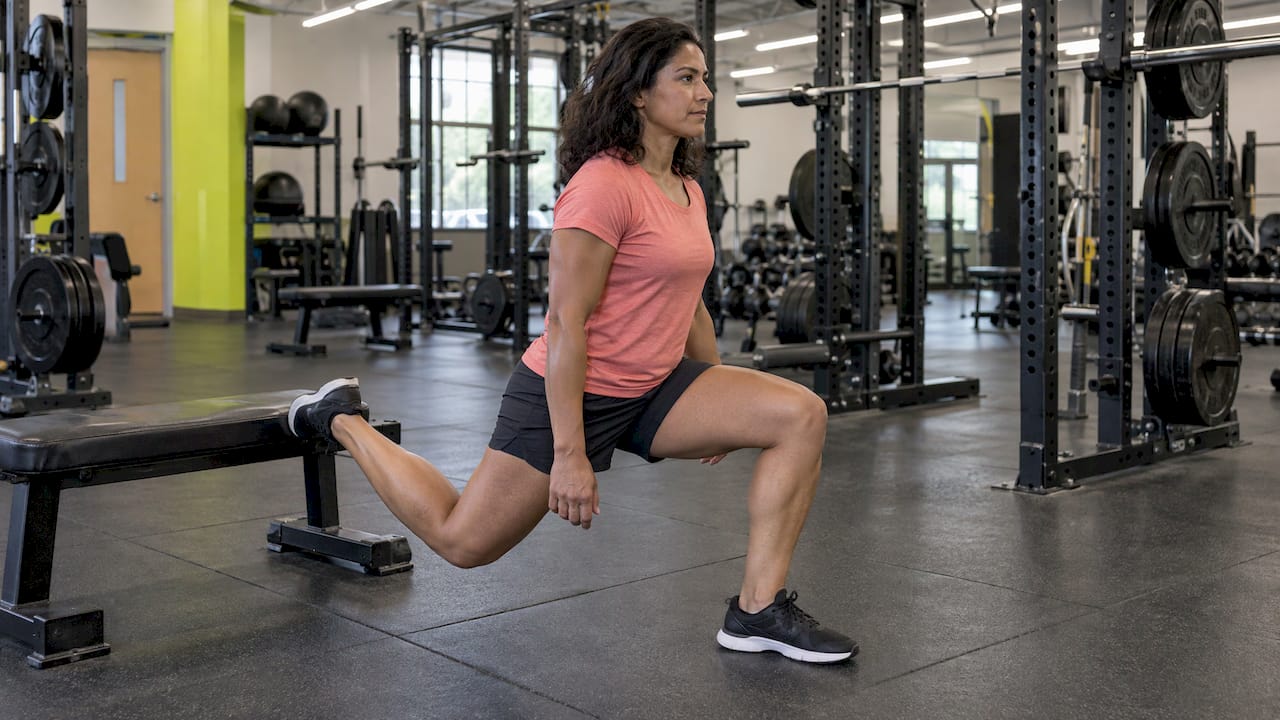
If one side is clearly weaker, or your knees cave, heavy single-leg work targets the gap with less spinal loading. Rotate in reverse lunges, split squats or pistol progressions for a three to four week block on your heavy squat days. Our list of single leg exercises gives twelve options with three plans, and the pistol squat guide covers progressions if you want a harder variant.
Frequency and rep ranges
If you squat once a week, a second session, lighter or more technique-focused, gives you more practice at the pattern. The same guide on squat plateaus suggests going from once to twice weekly, or twice to three times, with at least one day devoted to technique. Responses to training styles vary, so treat it as an experiment you can log and reverse. Add volume or frequency only if your recovery numbers from the triage table look healthy.
Two rules keep any of these from becoming noise:
- Change one thing at a time. If you add pauses, a second squat day and a new rep range together, you will not know which one worked.
- Finish the block. BarBend notes that completing a full mesocycle, typically four to six weeks, before abandoning a program matters, because constant program-hopping makes loading inconsistent. The same logic applies to variations: give each one four to eight weeks.
A six-week plan you can run
Here is a worked example for a lifter who has confirmed a stall at 275 lb for five reps at parallel after eight weeks. This is a practice-based template, not a research protocol, so adapt it to your own schedule.
Week 0: Baseline. Film your top set. Write down depth, reps and RIR. Check sleep, protein and calories, and take a lighter week if it has been a long time since one.
Weeks 1 to 3: Pause block.
| Day | Work |
|---|---|
| Heavy day | Paused squat, 3 sets of 5 at about 80% of your usual top weight with a one-second pause, finishing around 2 to 3 RIR |
| Second day | Regular squat, 3 sets of 5 at a weight that leaves 3 or more RIR, focused on position |
| Accessory | Single-leg work, 2 to 3 sets of 8 to 10 per leg |
Weeks 4 to 6: Lengthen and load. Extend the pause to two or three seconds, then raise the weight only if the pause stays clean. In the final week, return to your regular squat and compare the top set with your week 0 numbers at the same depth and RIR.
Judging the result. If your regular squat rises, or the same weight now moves with more reps in reserve, the weak point was the limiter. If nothing moves, go back through the triage table, because recovery or context is the likelier culprit. Do not test a heavy single every week or two, since frequent max testing tends to measure fatigue more than strength. Track working weights and rep PRs in between, and test a true max only a few times a year.
Track it so you can see it
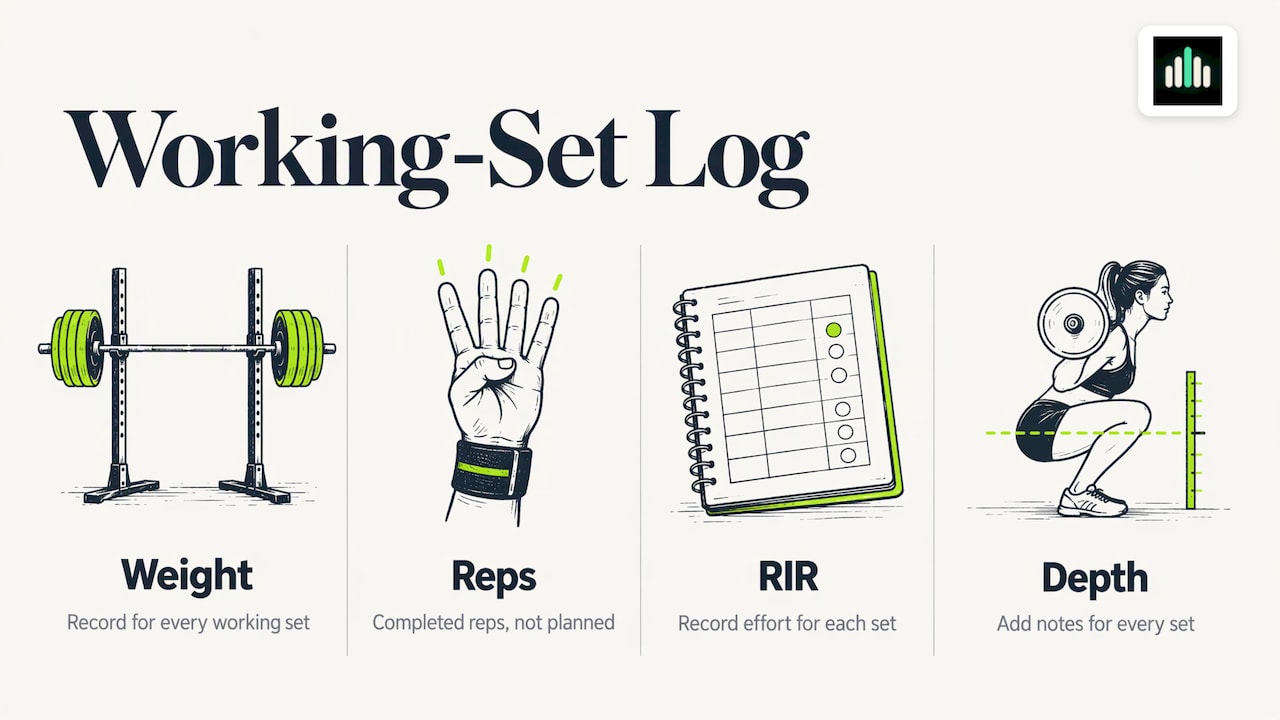
Every source above lands on the same practical advice: keep a record. Untracked training makes it hard to evaluate progression, and a log with effort ratings lets you see trends and judge adjustments. Write down weight, completed reps (not planned ones), RIR and depth notes for every working set. Our guide on how to log workouts lists what to record and how, and if you want a broader view of stalls across lifts, see how to break a lifting plateau.
Let your logs pick the next load
A plateau diagnosis needs data, and the next load needs a decision. RIRLift lets you log every set with weight, reps and RIR on your iPhone or Apple Watch, and its AI Coach analyzes your session logs to recommend the next load and adjust future sets. It works strictly from your own training data, and you can talk to Coach about adjustments. The Apple Watch app is built so you can train with just your watch if you want.
Core features are free. RIRLift Pro, which unlocks advanced coaching, analytics, unlimited routines and customization, is $9.99 per month or $79.99 per year through the App Store. You can start on the RIRLift home page.

If you want to see how logs turn into programming, the AI workout planner page explains how the plan follows your sets.
FAQ
How long should I wait before calling it a squat plateau?
About six to eight weeks of consistent training with no improvement in load, reps or estimated 1RM, while effort and depth stay the same. Anything shorter is more likely a bad stretch than a plateau. If you have not had a lighter week recently, take one first and see what happens.
What is the fastest way to break a squat plateau?
There is rarely a fast fix, but the quickest sensible route is to rule out fatigue, then target your weak point with one change, such as paused squats, for four to eight weeks. Changing several things at once makes it impossible to know what worked.
How much should a 250 lb man be able to squat?
It depends on training experience, age and the standard you use. Our squat standards tool shows levels by body weight, and the squat max chart converts a top set into percentages and working loads. Use them as reference points, not as a verdict on your progress.
Should I squat more often to get past a plateau?
Often, yes, if recovery allows. Going from one session a week to two, with one lighter or technique-focused day, gives extra practice at the pattern. Log the change so you can check after a few weeks whether your top sets actually improved.
Sources
- Plateau or Impatience? Understanding the Difference, Powerlifting.com
- Troubleshooting a Nonresponder: Guidance for the Strength and Conditioning Practitioner, PMC
- The Back Squat Part 2: Targeted Training Techniques, PMC
- Understanding and Overcoming the Sticking Point in Resistance Exercise, PMC
- How to Implement Paused Squats, Stronger by Science
- 17 Ways to Break Through a Stubborn Squat Plateau, BarBend
- 9 Tips To Break Through A Squat Plateau
- How to Strengthen Your Lower Back