
The workout app for muscle gain that tells you what to lift next
Published October 27, 2026
Muscle gain needs a plan you'll repeat for months, weights that go up as you get stronger, and a way to tell whether the scale is climbing for the right reasons. RIRLift gives you all three, free on iPhone and Apple Watch. Pick or build a plan for your days, log weight, reps and how many reps you had left, and the next session's weights are set for you. Bodyweight, body fat and 13 body measurements sit next to your strength trends.
Free on iPhone and Apple Watch · No account · Coming to Android: join the waitlist
What muscle gain needs from a workout app
-
A plan that fits your week
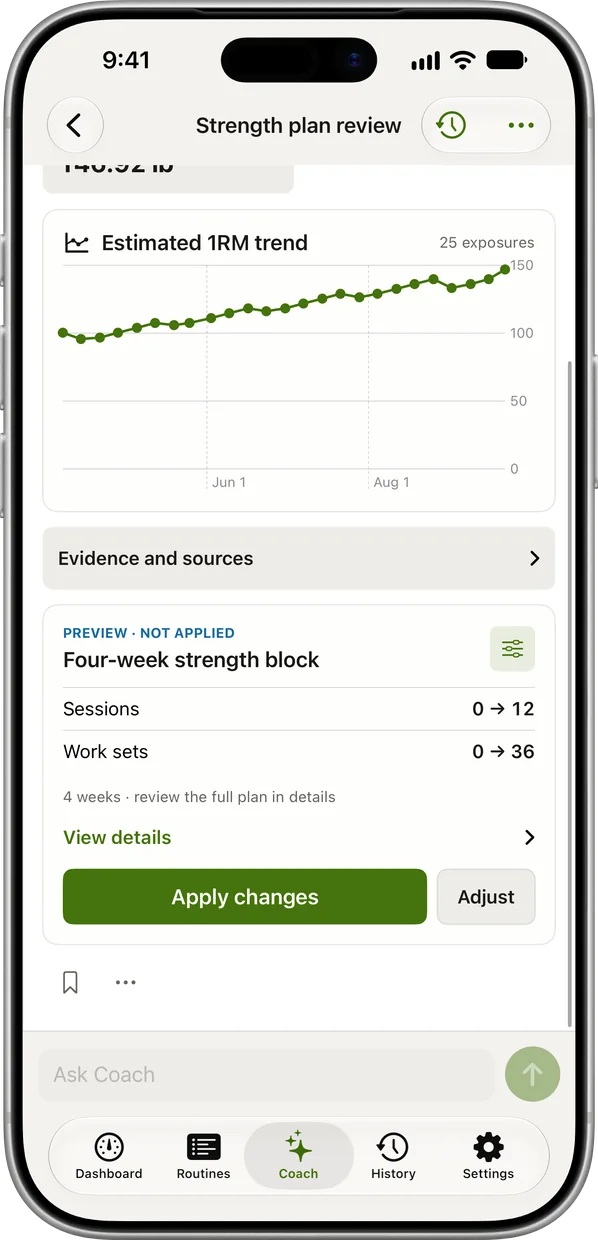
Add a ready-made program from the library, or ask Coach to build one for your days and equipment. The plan arrives as a preview, and nothing is added until you tap Apply changes. Already have a program? Type it into the web planner on a computer and import it.
-
Progressive overload you don't calculate
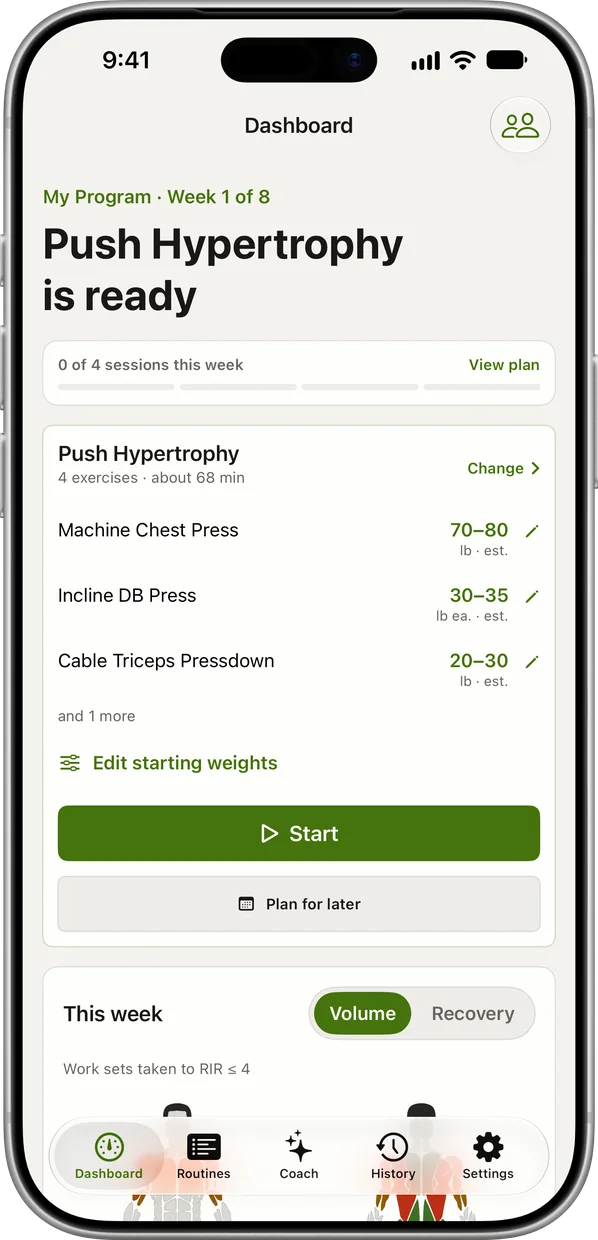
When every set reaches the top of the rep range, the weight goes up one step next session. Otherwise it holds and you aim for one more rep. Each exercise opens with its weight already filled in. The progressive overload guide explains the rule.
-
Track muscle, not just the scale
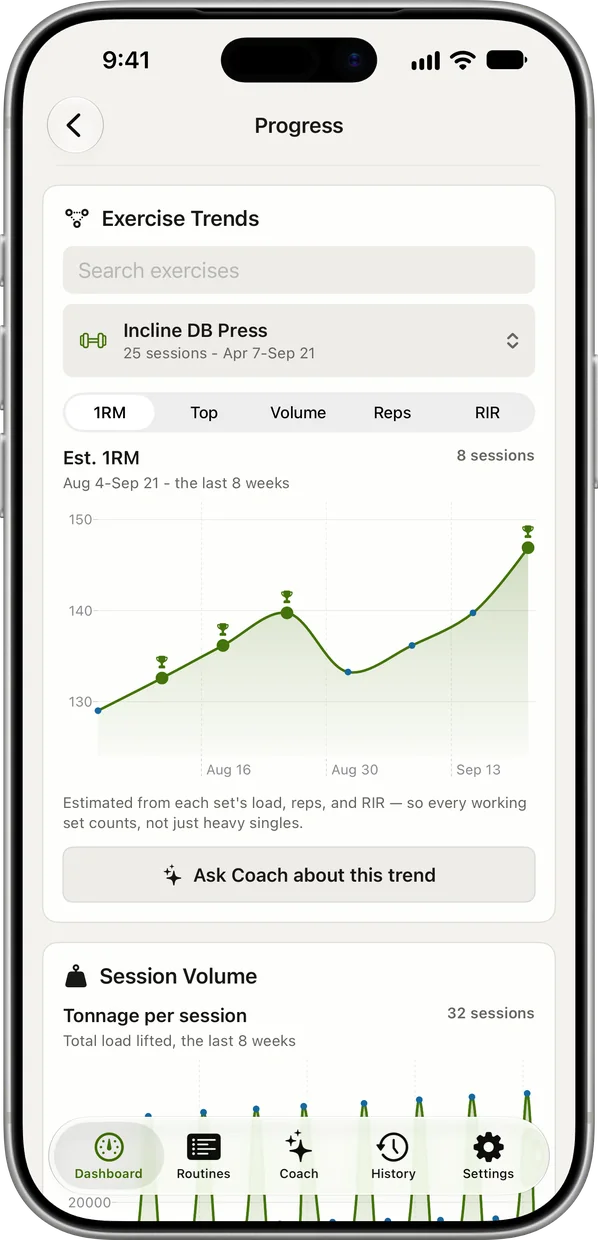
Log bodyweight, body fat and 13 body measurements, from arms to thighs. Read them next to each lift's estimated 1RM trend: a rising scale with rising lifts and arms is a different story from a rising scale alone. More in am I gaining muscle or fat?.
-
Enough sets for every muscle
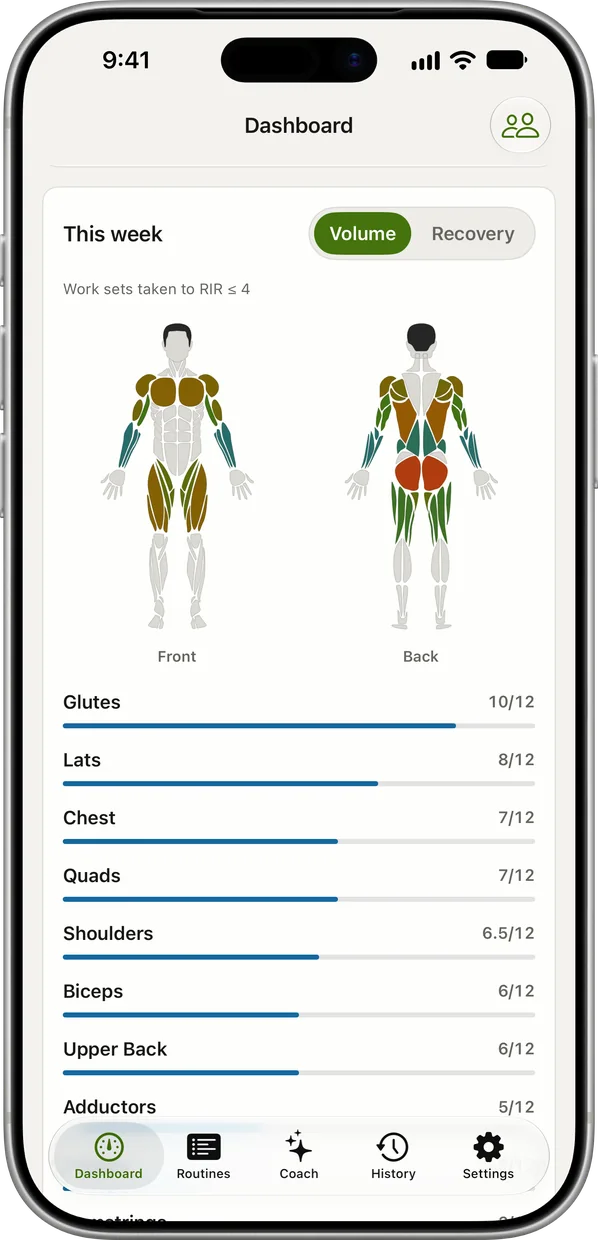
The weekly muscle map counts this week's sets per muscle, so a forgotten muscle shows up before the week is over.
-
Free, with no account
Unlimited workouts, the weight suggestions, the weekly muscle map and up to 4 active routines are free. Pro adds more Coach conversations, unlimited routines and all-time analytics.
Building muscle, session by session
Upper day on a four-day upper/lower, eating to gain
A year of lifting, gaining about half a pound a week. Big lifts stop 2 reps short of failure, the rest 1 rep short.
| Exercise | You logged | Next session | Why |
|---|---|---|---|
| Barbell Bench Press | 205 lb, 10 / 10 / 10 / 9 reps, 2 left (target 9) | 205 lb × 10 | The weakest set hit 9. Same weight, aim for 10 on all four sets. |
| Dumbbell Shoulder Press | 50 lb pair, 12 / 12 / 12 reps, 1 left | 55 lb × 8–12 | Every set at the top of 8–12. Next dumbbell up, reps back to 8. |
| Lat Pulldown | Set 1: 140 lb, 10 reps, 3 left (target 10, 1 left) | Set 2: 145 lb | Two more left than planned. 140 × 42 ÷ 40 is 147 lb, rounded to the stack's 145. |
The bench is a rep away, the press moved up, the pulldown went up mid-session. Each lift moves on its own evidence.
Lower day: some sets were easy
Same plan. Eating more shows up on the leg press first.
| Exercise | You logged | Next session | Why |
|---|---|---|---|
| Leg Press | 360 lb, 15 / 15 / 15 / 15 reps, 1 left | 365 lb × 10–15 | All four sets at the top of 10–15. One step on your plates, 2.5 lb a side, reps back to 10. |
| Seated Leg Curl | 100 lb, 13 / 12 / 12 reps, 1 left (target 12) | 100 lb × 13 | The weakest set hit 12. Hold the weight, add a rep. |
| Standing Calf Raise | Set 1: 180 lb × 15, 4 left (target 1) · sets 2–3: 190 lb × 15 / 15, 1 left | 200 lb × 10–15 | Set 1 was clearly easier than planned, so set 2 went up: 180 × 48 ÷ 45 = 192, rounded to the stack's 190. Both sets at 190 topped the range: one stack step. |
Reps decide whether the weight goes up next time. A set that's clearly easy moves it up the same day.
Three-day push/pull/legs, a new lift on pull day
Training three days a week and adding hammer curls for the first time.
| Exercise | You logged | Next session | Why |
|---|---|---|---|
| Hammer Curl | 20 lb (Estimate), 20 reps, nothing left | 25 lb × 10–15 | The first set measures you. 20 reps to failure at 20 lb converts to about 25 lb for 10 reps to failure. |
| Pull-Up | Bodyweight, 10 / 9 / 8 reps, 1 left (target 8) | Bodyweight × 9 | Bodyweight lifts progress by reps until you add weight. The weakest set hit 8, so aim for 9. |
| Incline Dumbbell Curl | 25 lb, 12 / 12 / 12 reps, 1 left | 30 lb × 8–12 | Every set at the top of 8–12. Next dumbbell, reps back to 8. |
A new exercise needs one set to find its weight. After that it progresses like the rest.
Muscle-gain plans that open in RIRLift
-
The best workout routine for the days you can train
4 days a week: upper/lower
The four-day plan in the first two examples: each muscle twice a week, more sets than full body fits.
4× a week · 68 sets a week · ~40 min
Add to RIRLiftSee the planAdd to RIRLift
Scan with your iPhone camera to add this plan.
-
The best workout routine for men, for your week
Busy: 3 gym days, push/pull/legs
Three gym days, each with a clear job. The plan in the third example.
3× a week · 48 sets a week · ~40 min
Add to RIRLiftSee the planAdd to RIRLift
Scan with your iPhone camera to add this plan.
Make it fit you
-
Ask Coach for a plan
Tell Coach which days you train and what you want to grow. It builds the workouts inside your equipment and shows a preview to apply or adjust.
-
Log measurements every couple of weeks
Add bodyweight, body fat and the sites you care about, like arms, chest and thighs. Measure at the same time of day each time.
-
Tell it what your gym has
Save your gym and its machines. Plans and swaps stay inside that equipment, and each machine remembers its own loads.
-
Keep training days on a reminder
Choose when you train. If two days pass with nothing planned, the Dashboard offers to pick a time and remind you.
-
Bring your history
Coming from Hevy, Strong or FitNotes? Import your log and Coach reads it from day one.
When a different app fits better
- You want calories and macros tracked for a bulk. RIRLift tracks training, bodyweight and measurements, not food. Pair it with a nutrition app.
Questions
What is the best workout app for muscle gain?
One that gives you a plan you'll stick with, raises the weight when your sets earn it and tracks more than the scale. RIRLift does all three for free on iPhone and Apple Watch.
How many days a week should I train to build muscle?
Three to four days works for most people, as long as each muscle is trained about twice a week. The best workout routine has a plan for three, four and six days.
How fast can I gain muscle?
It depends mostly on training age. Newer lifters gain fastest, and the rate slows each year. The muscle gain calculator estimates a realistic monthly rate for you.
Is RIRLift a bulking app?
It's the training half of a bulk: the plan, the weights and the measurements. Pair it with a nutrition app for the food half.
How do I know I'm gaining muscle and not just fat?
Watch your lifts and your measurements together. Rising strength with growing arms and a steady waist means muscle. A rising waist with flat lifts means slow the surplus.
Read next
-
The best workout routine for the days you can train
The four-day upper/lower in full, with every exercise demonstrated.
-
Muscle gain calculator
A realistic rate of muscle gain for your training age.
-
Am I gaining muscle or fat? What the scale won't tell you
How to read the scale, the tape and your lifts together.
-
Progressive overload: a practical guide
The rule behind every weight in the examples.
-
Upper/lower split: why the upper day decides if it works
How to set up the four-day plan above.
More ways lifters use RIRLift
-
The hypertrophy app that sets your load from reps in reserve
RIR on every set, weekly sets per muscle, and deloads when a lift stalls instead of on a calendar.
-
The workout app for skinny guys who want to put on size
A three-day plan on the big lifts, starting weights that fit a light frame, and the bar loaded up as you grow.
-
The bodybuilding app that counts every set and sets the next weight
Run a size split, see weekly sets per muscle, and let each set's reps in reserve decide the next weight.
-
The body recomposition app that shows what the scale can't
Lifts that keep climbing at maintenance, with body fat and 13 measurements to prove the recomp is working.