Blog
3-Day Weight Training Split: How to Pick and Progress It
Published November 25, 2026 · 15 min read

Scan with your phone camera
Three lifting days a week is enough to build strength and muscle, provided each muscle is trained about twice a week and your weekly hard sets add up to roughly 10 or more per muscle for growth. The split you choose matters less than whether you log every set and add load on schedule, which is exactly what RIRLift is built to do on iPhone and Apple Watch.
This guide helps you pick a layout, space the days, build a week you can run for months and decide when to add weight. If you want a deeper look at one structure, the linked pages on our blog cover them individually.
TL;DR
- Three sessions per week can build strength and muscle when weekly volume is adequate, because research comparing frequencies finds little difference once volume is matched.
- Full body three times a week is the default. Upper/lower/full-body rotation suits lifters who want more sets per session, and push/pull/legs trains each muscle only once a week.
- Aim for about 10 or more hard sets per muscle per week for size, and train main lifts at heavy loads (80% of your one-rep max or above) for strength.
- Space sessions with a rest day between them, such as Monday, Wednesday and Friday.
- Progress by logging weight, reps and reps in reserve (RIR) for every set, then raising the load when you hit the top of your rep range with reps to spare.
Table of Contents
- Why three days a week is enough
- The three layouts for a 3-day split
- How to space the three days
- A sample week you can run
- Progression: the part that makes a 3-day split work
- Mistakes that stall a 3-day plan
- Tracking your sets with RIRLift
- FAQ
- Sources
Why three days a week is enough
The worry behind most searches for a 3-day split is simple: is this too little? The research says it is not, as long as the work you do each week is sufficient.
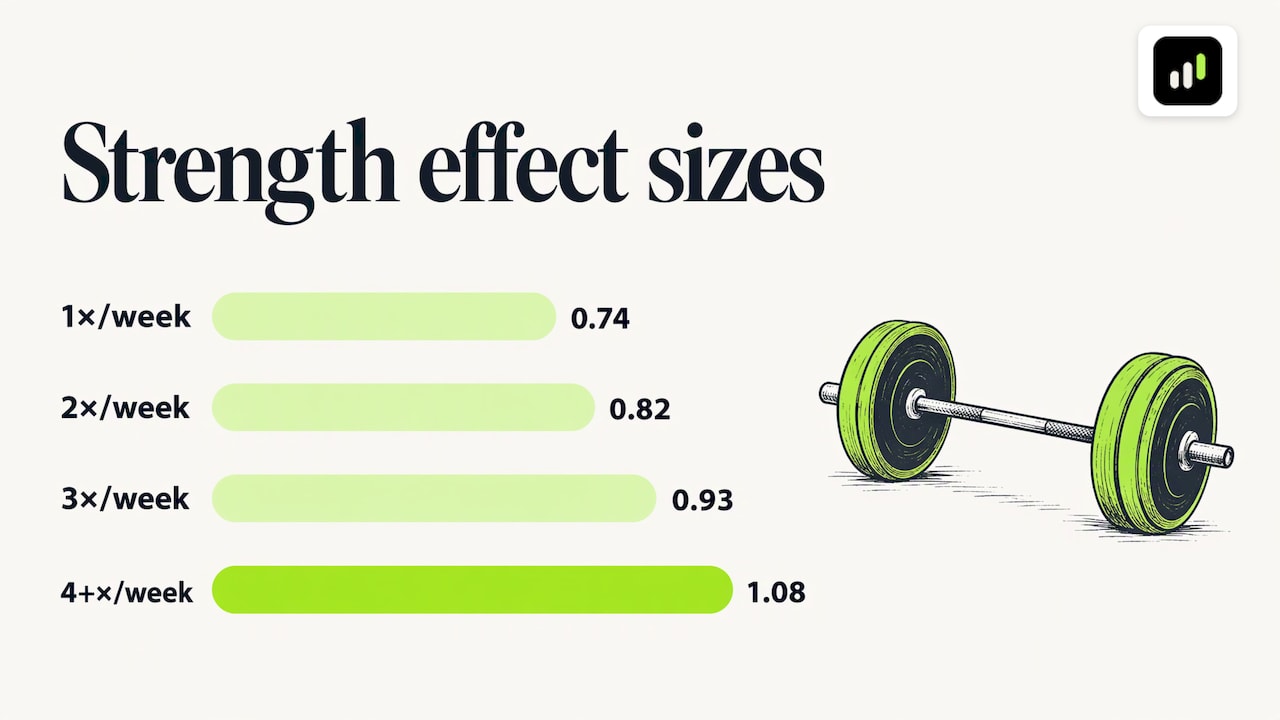
A 2018 meta-analysis of 22 studies on training frequency found that more frequent training looked better for strength at first glance, with effect sizes of 0.74, 0.82, 0.93 and 1.08 for training one, two, three and four or more times per week. But when the researchers compared studies with volume equated, the frequency effect was no longer significant (p = 0.421). In plain terms, frequency mostly helps by letting you fit more total work into the week.
A 10-week study of 36 resistance-trained men found that two versus three sessions per week produced similar gains in strength and muscle size when volume was matched, with no significant differences between groups. A 2021 review on time-efficient training reached a similar conclusion for strength: a lean schedule works if weekly volume is preserved.
The 2026 American College of Sports Medicine position stand, an overview of 137 systematic reviews, adds the numbers to aim for. It found that strength improves with loads at or above 80% of your one-rep max for 2 to 3 sets at the start of sessions, at least twice a week, while hypertrophy (muscle growth) improves with 10 or more sets per muscle per week. The same overview found that factors like set structure, time under tension and periodization did not consistently change outcomes for healthy adults. So you do not need an elaborate plan. You need enough hard sets, heavy enough work, done consistently.
A hard set, to be clear, is a set taken close enough to failure that the last reps are slow and demanding. That is where reps in reserve comes in: RIR is the number of reps you could still have done when you stopped. A set finished with 2 RIR means you stopped two clean reps short of failure. Our guide to reps in reserve explains how to judge it.
The three layouts for a 3-day split
There are three practical ways to arrange three sessions. They differ mainly in how often each muscle is trained and how many exercises you can fit per muscle in a session.
| Layout | How the week looks | Times each muscle is trained | Best for |
|---|---|---|---|
| Full body, three times | Day A, Day B, Day C, each with a squat or hinge, a press, a pull and some arm or shoulder work | 3 | Beginners, strength focus, lifters who skip sessions occasionally |
| Upper, lower, full body | Upper on day 1, lower on day 2, full body on day 3, rotating the order each week | About 2 | Intermediates who want more exercises per muscle |
| Push, pull, legs | Push day, pull day, leg day | 1 | Lifters who enjoy longer, focused sessions and have time to spare |
The push/pull/legs row deserves a note. Run once through in a week, each muscle gets one session, which falls short of the twice-weekly pattern for growth. Our push pull legs breakdown and the push pull legs app page show how the same structure works when you run it across more days. On three days, full body or the upper/lower/full rotation hits muscles more often.
Full body three times a week
Every session trains the whole body, so each muscle is hit three times. Because you cover everything every day, you pick fewer exercises per session and choose the productive ones: squats, presses, rows, hinges and pull-downs. The upside is that every main lift gets practiced three times a week, and missing a day costs you one third of your week instead of a whole muscle group. If you want ready-to-run templates, see our full body workout plans and the full body split arithmetic.
Upper, lower, full body
This rotation gives each muscle roughly two sessions per week. Week one might run upper, lower, full body. Week two runs lower, upper, full body, or you keep a fixed order. The extra room in upper and lower days lets you add a second exercise for a muscle you want to bring up, so it suits lifters who have outgrown the minimal full-body session.
Push, pull, legs
This layout gives you long sessions with plenty of variety per muscle, and it is a good fit for lifters who are happy with once-a-week frequency per muscle and enough volume packed into each visit. If you are weighing this against more training days, the 4 day split and 5 day split articles show what each extra day buys you. The question of how often to hit a muscle is covered in training frequency for hypertrophy.
How to space the three days
The standard pattern is Monday, Wednesday, Friday, which leaves a rest day between sessions and two days at the weekend. A coach with a trained muscle in mind wants roughly 48 to 72 hours before it is hit again, and that spacing delivers it. Tuesday, Thursday, Saturday works equally well, and so does any pattern with at least one rest day between sessions.
If your life does not allow alternating days, two days on and one day off is workable for upper/lower/full-body rotations, because the upper and lower days use different muscles. Avoid running a full-body session on back-to-back days, since the same muscles are asked to perform before they have recovered.
A practical point on recovery: muscle is built between sessions, so sleep and food are part of the plan. Shawn Arent, chair of the Department of Exercise Science at the University of South Carolina, makes this point in Men's Health: too little frequency means too little repeated stimulus, but extra sessions without adequate nutrition and rest backfire. Three well-recovered sessions beat four ragged ones.
A sample week you can run
The week below is a practice-based template, not a study protocol. It uses the full-body layout because it covers the twice-weekly guideline automatically and keeps sessions near 60 minutes.
| Exercise | Day A | Day B | Day C |
|---|---|---|---|
| Squat pattern | Back squat 4 x 5-8 | Leg press 3 x 8-12 | Front squat or split squat 3 x 8-10 |
| Hinge pattern | Romanian deadlift 3 x 8 | Deadlift 3 x 4-6 | Hip thrust or back extension 3 x 10 |
| Horizontal press | Bench press 3 x 6-10 | Dumbbell bench press 3 x 8-12 | Incline dumbbell press 3 x 8-12 |
| Vertical press | Overhead press 3 x 6-8 | Lateral raise 3 x 12-15 | Overhead press 3 x 8-10 |
| Pull | Chest-supported row 3 x 8-12 | Pull-up or lat pull-down 4 x 6-10 | Cable row 3 x 10-12 |
| Arms and calves | Curl 2 x 10-12, calf raise 3 x 10 | Triceps extension 3 x 10-12 | Curl 2 x 10-12, calf raise 3 x 10 |
Count the sets. Quads get about 10 hard sets across the week from the squat pattern, and chest, back and shoulders land in a similar range when you combine pressing and pulling days. That matches the ACSM overview's figure of 10 or more weekly sets for hypertrophy. Rest 2 to 3 minutes between heavy compound sets and 1 to 2 minutes between single-joint work, which agrees with what AUSactive's resistance exercise guidelines recommend for healthy adults training two to three times weekly.
If you are new to lifting, begin with 2 to 3 sets per exercise and add sets over a few weeks rather than starting at the top of the table. Beginners who want a lighter start can use the bodyweight full-body exercises while they learn the movements. If you train with dumbbells and a watch, our Apple Watch dumbbell workout shows three sessions built that way. A short warm-up helps too; the 15-minute sports warm-up template is a good starting point.
Adjusting the template to your goal
For strength, keep the main lift of each day heavy: sets of 3 to 6 reps at a load near or above the 80% of one-rep max threshold mentioned earlier, with accessory work at 8 to 12 reps. For size, keep rep ranges at 6 to 12 on most movements and make sure each muscle reaches its weekly set count. Both goals share the same skeleton. Only the rep range and the load on your first exercise of the day change.
Progression: the part that makes a 3-day split work
With only three sessions a week, you cannot afford sessions where nothing improves. Progress is the engine of the split, and it depends on knowing exactly what you did last time.
The simplest method is double progression. You pick a rep range, say 6 to 10 on the bench press. You work at a load until you hit the top of the range on every set, then raise the load slightly and drop back to the bottom of the range. The next time, you try to beat your reps again.
RIR makes this decision sharper. A set that reaches 10 reps with 4 reps left in the tank was too easy, so the load can jump more. A set that reaches 8 reps with 0 reps left tells you the load is right and the next target is a rep, not a jump. A practical rule is to work most sets at 1 to 3 RIR, and to raise the load once you hit the top of your range with at least 2 RIR on every set. This is a working rule used in coaching practice, not a result from a single study.
For each exercise, log three numbers per set: the weight, the reps and the RIR. Then ask three questions at the start of the next session:
- What did I lift last time, for how many reps, and how close was it to failure?
- Did I reach the top of the rep range on every set?
- If yes, what is the smallest sensible jump? On barbell lifts that is often 5 pounds for upper body and 5 to 10 pounds for lower body, and on dumbbells it is the next pair up.
Here is a worked example. On Monday you bench 175 pounds for sets of 8, 8 and 7, with RIR of 2, 2 and 1. The top of your range is 10, so you stay at 175 and aim for 9, 8 and 8. By the third week you hit 10, 10 and 9 at 2 RIR, so you move to 180 and start again near 8. Over a 12-week block, small steps like that add up to a heavier bench with no guesswork.
Watch for the trap that catches many three-day lifters: with 48 hours or more between sessions, soreness and fatigue are usually lower than on a five-day plan, so it is tempting to push every set to failure. Failure is not required. The ACSM overview did not find that training to momentary muscle fatigue consistently changed outcomes, and ending sets with a rep or two in reserve makes it easier to repeat the same quality in the next session.
Mistakes that stall a 3-day plan
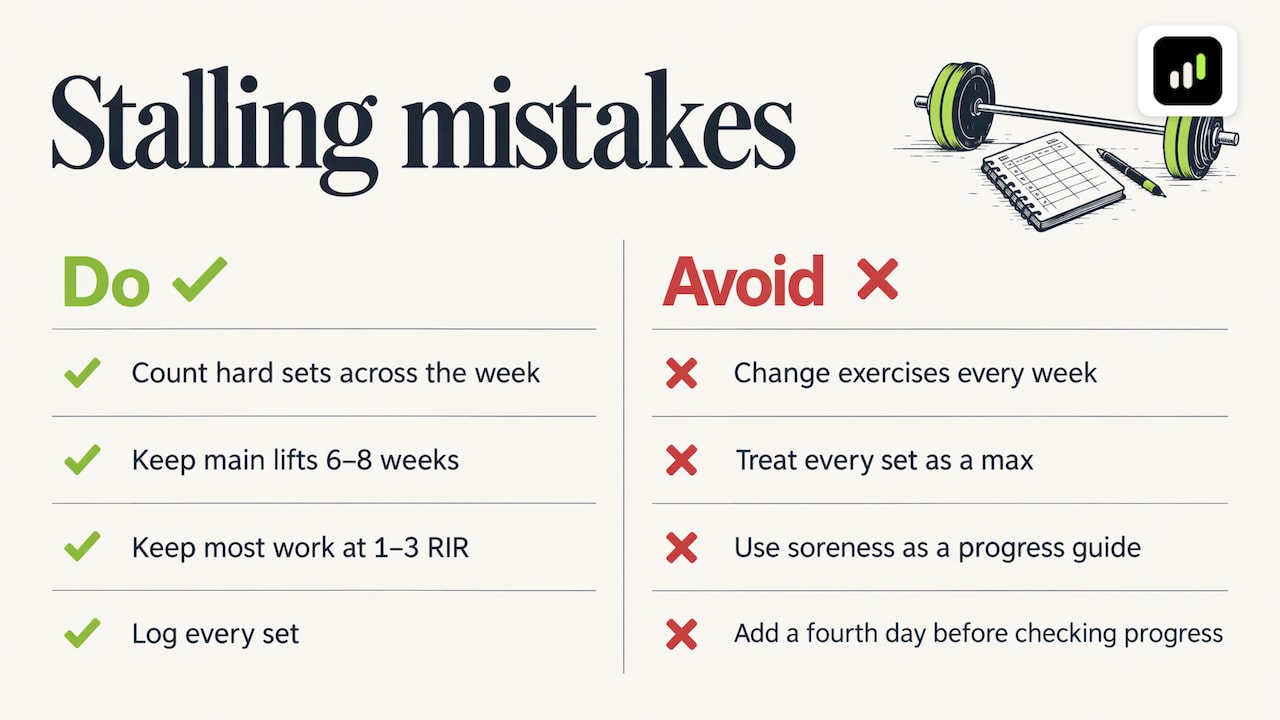
Skipping the volume count. Three days with two exercises each will not reach 10 sets per muscle. Count the hard sets per muscle across the week and add where you fall short.
Changing exercises every week. You cannot track progress on a movement you only do once. Keep the main lifts for at least a training block of 6 to 8 weeks, and rotate accessories only when they stall.
Treating every set as a max. Heavy singles and failure sets on every lift make the next session worse. Keep most work at 1 to 3 RIR and reserve harder efforts for the last set of an exercise.
Using soreness as the guide. Soreness is not a measure of progress. If it is severe, reduce the number of sets for a session or stop further from failure rather than skipping the next workout.
Moving to more days too early. Many lifters assume a fourth day will fix a stalled bench. Often the fix is better logging and a cleaner progression. Before adding a day, check that you have raised your loads or reps at least every two weeks.
Skipping the log. Memory is unreliable between sessions two days apart. Write down or record every set, because progression decisions rest on it.
Tracking your sets with RIRLift
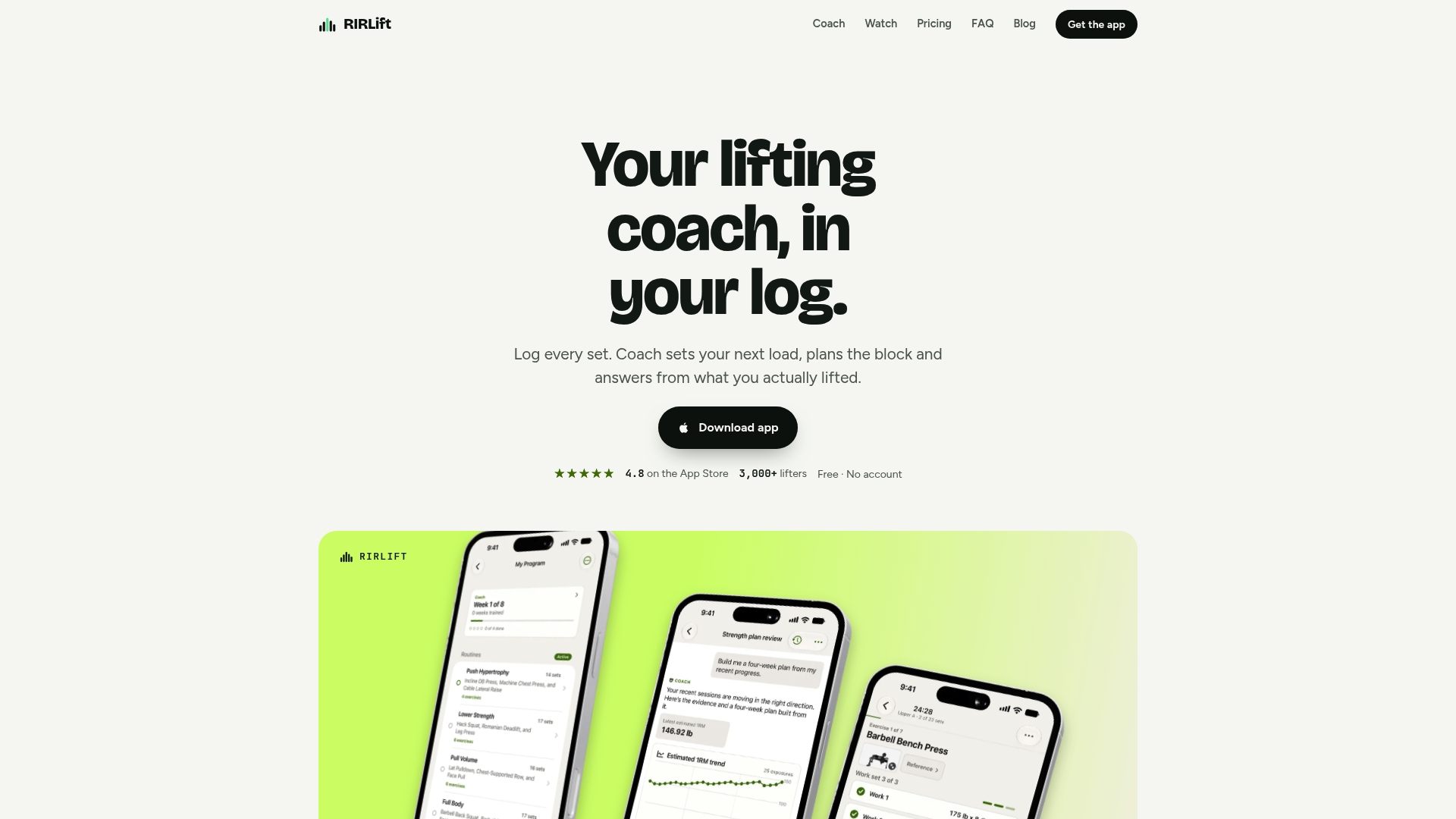
On a 3-day split, the quality of your log decides the quality of your progression. RIRLift records the weight, reps and RIR of every set on iPhone or Apple Watch, so you can train with just your watch if you prefer. Our Coach, the AI Coach inside the app, analyzes your logged sessions and recommends the next load based on your own data and your RIR input, and you can talk with it to adjust. The app also offers multi-week block planning, a weekly muscle map to check set counts, workout analytics, data import and export and Apple Health integration.
The core features are free, and the Pro plan, which unlocks advanced coaching, analytics, unlimited routines and customization, costs $9.99 per month or $79.99 per year. You can start on rirlift.com and put the sample week above straight into the app.
FAQ
Is a 3-day split enough to build muscle?
Yes, when weekly volume is adequate. The ACSM 2026 overview links hypertrophy to 10 or more sets per muscle per week, and studies comparing two and three weekly sessions with matched volume found similar gains in strength and muscle size. Three days works especially well in the first couple of years of lifting.
What is the best 3-day split for beginners?
Three full-body sessions per week is the best starting point, because each muscle is trained three times and you practice the main lifts often. Use 2 to 3 sets per exercise, keep a rest day between sessions and add small amounts of weight when you complete all your reps.
Can I do a 3-day split on non-consecutive days?
Yes, and that is the recommended pattern. Monday, Wednesday and Friday is the classic choice. Any arrangement with at least one rest day between sessions gives each muscle 48 hours or more to recover before it is trained again.
How long should each workout last?
Most three-day full-body or upper/lower sessions run 45 to 75 minutes including warm-up, depending on how many exercises you include and how long you rest. Heavy compound lifts need 2 to 3 minutes of rest between sets, so keep exercise selection tight if time is limited.
Sources
- Effect of Resistance Training Frequency on Gains in Muscular Strength (2018 meta-analysis)
- Similar Muscular Adaptations in Resistance Training Performed Two Versus Three Days Per Week (2019)
- No Time to Lift? Designing Time-Efficient Training Programs for Strength and Hypertrophy (2021)
- American College of Sports Medicine Position Stand overview (2026)
- How Many Days a Week You Should Work Out for Muscle, Weight Loss and Health (Men's Health)
- AUSactive Exercise Guidelines: Resistance Exercise Prescriptions for Healthy Adults (2022)