
A 5x5 app that adds the weight when you earn it
Published October 27, 2026
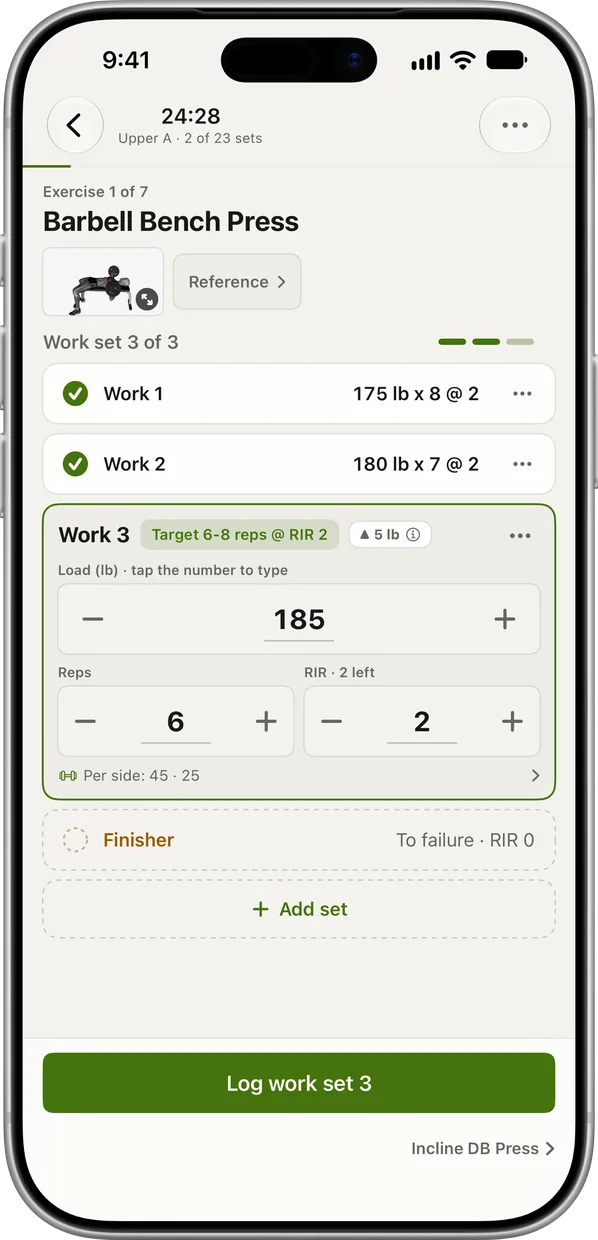
A 5x5 app has one job: tell you what to put on the bar today, and add weight only when all five sets of five went up. RIRLift does that for free on iPhone and Apple Watch. You log reps and how many you had left, it adds one plate step when every set lands, holds when one falls short, and offers a lighter week when a lift stops moving.
Free on iPhone and Apple Watch · No account · Coming to Android: join the waitlist
What a 5x5 lifter needs from an app
-
Today's weight on every lift, already loaded
Each set opens prefilled with the weight and reps from last time, adjusted for what you earned. A 5x5 session is mostly squat, tap Log, rest, repeat.
-
Weight goes up only when all five sets land
Set a lift to 5 sets of exactly 5. When every set reaches 5, the next session adds one step on your plates, usually 5 lb on the bar. If one set comes up short, the weight stays and you try again. The rule is judged on your weakest set, which is how 5x5 is meant to run.
-
A deload when a lift actually stalls
Three sessions without a new rep and the workout recap suggests about 10% lighter. You tap Deload or Not yet. No deload arrives just because a calendar says so. Deload week covers when one helps.
-
Plates per side, on the phone or the wrist
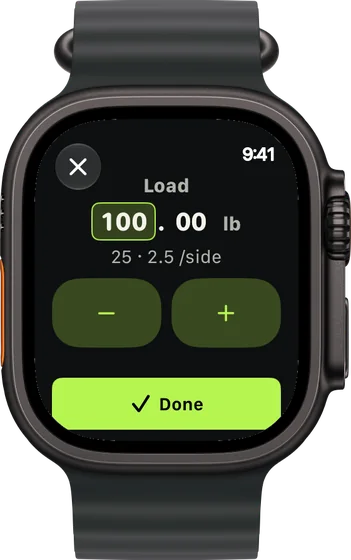
The plate calculator shows what to load for 185 lb or 102.5 kg, on iPhone and on Apple Watch. With Pro you can enter your own plates and bar, fractional plates included.
-
No max test before you start
New to a lift? It starts light, marked Estimate, and asks for one set of max reps. Already have numbers? Import your history from Hevy, Strong or FitNotes and Coach starts from it on day one.
A 5x5 block, session by session
Week 2, Workout A: squat, bench, row
Five sets of exactly 5 on each lift, aiming to finish each set with 2 reps left. Plates go down to 2.5 lb, so the smallest jump is 5 lb.
| Exercise | You logged | Next session | Why |
|---|---|---|---|
| Barbell Back Squat | 185 lb, 5 / 5 / 5 / 5 / 5, 2 left | 190 lb × 5 | Every set hit 5 at the planned effort. One step up. |
| Barbell Bench Press | 135 lb, 5 / 5 / 5 / 4 / 4, 1 left | 135 lb × 5 | The weakest set stopped at 4, so the weight holds. Five sets of five at 135 is still the target. |
| Barbell Row | Set 1: 115 lb × 5, 4 left · sets 2–5: 120 lb × 5, 2 left | 125 lb × 5 | Set 1 had two more reps left than planned, so set 2 went up: 115 × 38 ÷ 36 ≈ 121, loaded as 120. Every set at 120 hit 5 on plan: one step up. |
Three lifts, three different answers, all from the same five-sets-of-five rule. You never decide on the gym floor.
Workout B: adjusting between sets
Same block, Workout B. The first set of each lift tells the app whether today's weight was right.
| Exercise | You logged | Next session | Why |
|---|---|---|---|
| Barbell Overhead Press | 85 lb, 5 reps, 4 left (planned 2) | 90 lb for set 2 | You had two more reps than planned. 85 × 38 ÷ 36 ≈ 90 lb, a weight you can load. |
| Barbell Deadlift | 225 lb, 4 reps, nothing left | 205 lb for the next set | Below the 5 you were asked for. 225 × 33 ÷ 36 ≈ 206, rounded to 205 lb. |
| Barbell Back Squat | 205 lb, 5 reps, 1 left (planned 2) | 205 lb | You got all 5 reps, just closer to failure than planned. The weight holds; you aren't cut for pushing. |
A bad first set doesn't cost you the session. The next set is corrected, and the change is marked as a correction.
Week 7: the bench press stops moving
Linear progress always runs out, upper-body lifts first. Here bench and overhead press have stopped adding reps for three sessions.
| Exercise | You logged | Next session | Why |
|---|---|---|---|
| Barbell Bench Press | 155 lb, 5 / 5 / 4 / 4 / 3, third session in a row | 140 lb × 5 if you tap Deload | No new rep in three sessions. The recap offers about 10% lighter: 155 × 0.9 ≈ 140 lb. |
| Barbell Overhead Press | 95 lb, 5 / 4 / 4 / 4 / 3, third session in a row | 85 lb × 5 if you tap Deload | Same stall, same offer: 95 × 0.9 ≈ 85 lb. Tap Not yet to keep trying at 95. |
| Barbell Back Squat | 245 lb, 5 / 5 / 5 / 5 / 5, 2 left | 250 lb × 5 | The squat is still moving, so it keeps climbing. Deloads are per lift. |
The lift that stalled backs off; the ones still moving keep going. You decide, the app does the arithmetic.
Barbell plans for where your 5x5 goes next
-
The best workout routine for men, for your week
Stronger squat, bench press and deadlift
Squat, bench and deadlift at 3 to 5 reps, three days a week, with accessories. The natural next step once 5x5 stops adding weight every session.
3× a week · 49 sets a week · ~55 min
Add to RIRLiftSee the planAdd to RIRLift
Scan with your iPhone camera to add this plan.
-
The best workout for full body, for your week
Full gym, 3 days: heavy, moderate, light
Still three full-body barbell days, but one heavy, one moderate and one light, so each lift gets more total work without grinding fives every time.
3× a week · 50 sets a week · ~45 min
Add to RIRLiftSee the planAdd to RIRLift
Scan with your iPhone camera to add this plan.
Make it fit you
-
Build Workout A and B once
Make two routines: squat, bench, row; and squat, overhead press, deadlift. Set each lift to 5 sets of exactly 5, or deadlift to 1 set of 5. The web planner on a computer is the quickest way, then import it. Or ask Coach to build it.
-
Set the effort target
A target of 2 reps left keeps early sessions honest and leaves room to grow. The app compares what you logged with that target to pick the next set and the next session.
-
Choose how fast it climbs
Settings has three paces. Standard adds one step when every set lands. Push takes bigger jumps and waits longer before suggesting a deload. Steady takes smaller steps.
-
Confirm weights before they're saved
Set Coach to Ask first and next session's weights appear on the recap. Nothing is saved until you confirm, so you can keep a lift where it is.
-
Warm up without doing the math
Warm-up sets are planned per lift and never count toward progress. The warm-up sets guide explains how many a heavy five needs.
When a different app fits better
- You want every weight set as a percentage of a tested max, on a fixed schedule. RIRLift sets weights from your logged sets, not from a max table. A spreadsheet or a percentage-based program fits better.
Questions
Is there a free 5x5 app?
Yes. RIRLift's free tier includes unlimited workouts, the weight suggestions, progression, deload offers and up to 4 active routines. A 5x5 uses two. No account and no ads.
Can I run a StrongLifts-style 5x5 in RIRLift?
Yes. Two alternating workouts, five sets of five, three days a week, weight added when every set lands and a lighter week offered after repeated misses. You build the two routines once; the app runs them.
How much weight should I add each workout?
One step on your equipment when every set hits 5: usually 5 lb on the bar. If every set was clearly easier than planned, the jump can be two steps. It never jumps more than that.
What happens when I fail a weight?
Miss a rep and the weight holds next session. After three sessions with no new rep, the recap suggests about 10% lighter and you choose. A single missed workout changes nothing.
What should I run after 5x5?
When fives stop moving, most lifters switch to fewer heavy sets plus lighter volume. See GZCLP, the Texas Method, or the heavy/moderate/light plan above.
Read next
-
Greyskull LP: how the last set tells you what to do next
A linear barbell program close to 5x5, with an AMRAP last set.
-
GZCLP program: how the stall ladder shows a drop coming
A common next step once straight 5x5 runs out.
-
Beginner Strength Program: 8 Weeks, 3 Days a Week
How a first barbell program is built and progressed.
-
Squat: how to do the barbell back squat, what it works and what to swap in
Form for the lift you'll do every 5x5 session.
-
Barbell calculator
Plates per side for any weight, before you open the app.
-
How RIRLift picks your next weight
The full rules behind the examples on this page.
More ways lifters use RIRLift
-
The strength training app that turns heavy sets into your next weight
Heavy sets of 3 to 5, a weight for every one, and a clear answer when a lift stops moving.
-
The powerlifting app for building your squat, bench and deadlift
Heavy triples adjusted set by set, plate math on your wrist, and no max test to get started.
-
The progressive overload app that decides your next weight
Next weight and rep target set from your weakest set, corrected between sets, with stalls caught early.